Monday, March 2, 2026

BLACK ARCHIVE // SECOND DESCENT Curated Existence Protocol __________\\


The moon had finished buffering.

It hung over a different intersection of the Unwritten now, no longer a perfect coin but a peeled eye, all crater and scar, its light falling in hard, surgical planes. The rain had thinned to a mist of untranslated timestamps, each droplet a date that had almost happened and then been revoked. They beaded on the air like sweat on invisible skin.

The crossroads itself had shifted, rotating along axes only archivists and dead gods could track. The four Unroads were still there, but they had grown teeth. Their verges were lined with ruinous billboards that did not advertise, only remembered: obsolete manifestos, rusted recruitment sigils, flickering treaty-clauses that looped and contradicted themselves until their sentences bit their own tails.
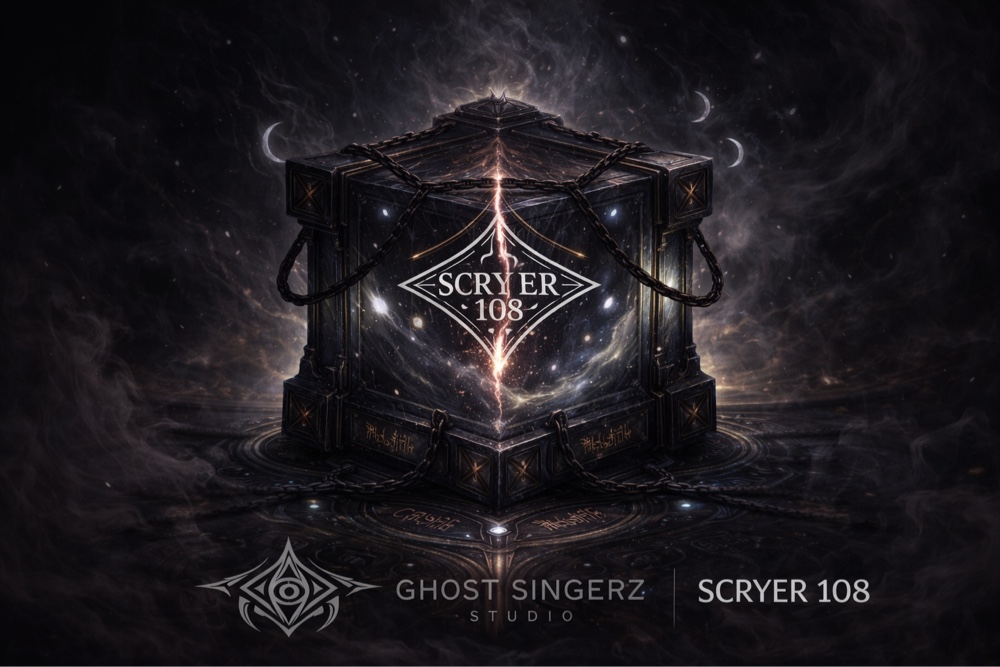


Scryer_designate_108 was no longer alone at the center.

He had left, and something of him had never left, and now that ghost—compiled from question-echo and choice-debris—had grown a body of its own. It wore his lamellar coat of fiber optics, but the colors beneath the strands were muted, as if someone had bled the saturation out. Its face-screen bore no fractures, only a single vertical dead-pixel line running over the left eye-socket like a printed tear.

Scryer108 watched his remnant from the roadside, half-folded into a layby of unreal traffic. He had not meant to come back. He had come back all the same.

They did not acknowledge each other. The crossroads discouraged self-recognition; it treated it like a looped error. Instead, the Unwritten summoned its answerer.

Across the not- asphalt, realities began to arrive.

They did not step out of portals. They did not descend in chariots of flame. They bled in through the margins of perception, like water through unfinished walls. First came sound: marching feet without bodies, the growl of engines designed for theaters that no longer existed, the whisper of treaties being read aloud in empty rooms. Then came color, streaming from the torn edges of the world: banners without nations, pale insignias of thought-factions, UV sigils that made Scryer108’s augmented eye ache.

Last came the envoys.

They walked in from four horizons at once, their paths curved but converging. Each carried the mark of a stalemated cosmos on their flesh.

From the northern Unroad came a woman whose armor was made of locks. Padlocks, biometric seals, crystalline shunts; a lattice of closures welded together. Nothing beneath them shone, but sometimes something pressed from within, testing. Her left hand was bare and utterly vulnerable. She kept it at her side like a weapon.

Defense incarnate.

From the east staggered a priest-machine, its chassis carved with glyphs of proportional retaliation, its many lenses reflecting nothing but its own armored surfaces. A censer swung from one titanium wrist, trailing equations for escalation curves encoded in smoke. Where its mouth should have been, there was only a narrow opening from which fine white dust poured. Countermeasure ash. Nullification made particulate.

From the south walked a child, barefoot, wearing a crown of tangled antennae. Tiny shards of broken satellites glittered in her hair. She carried no shield and no weapon, only a glass cube in which a hundred miniature moons orbited a shard of burned paper. Each moon bore trenches and impact scars. Her eyes were too old for the face that carried them.

From the west approached something that refused a single shape. It warped with every step, cycling through uniforms—general, insurgent, bureaucrat, analyst, hermit—each dissolving into the next like frames in a corrupted file. Its skin was made of translucent contracts, layers of language showing through. Where its heart would be, a knot of black rope pulsed slowly, tied and retied by invisible hands.

They stopped at the crosshairs of the intersection, equidistant, the ghost of Scryer between them like an unacknowledged host. Scryer108, at the roadside, felt the Unwritten’s attention contract, honing itself into a blade-fine focus.

The question still hung over the place. It had not dissipated in his absence. It had fermented.

When the defenses of war are equal and no one can win, how will wars be fought?

The envoys did not answer with words. They set down their offerings.

The locked-woman reached up and unlatched one of the mechanisms from her breastplate. It was a circular seal of dark glass, banded with runes of prohibition. She laid it on the crossroads, and it sank halfway into the surface, humming like a low, discontented throat.

The priest-machine knelt with awful elegance and poured a thin line of countermeasure ash around the seal, enclosing it in a pale ring. Equations for “mutually assured” and “proportionate response” flickered through the dust, then dimmed, their variables emptied.

The child with the satellite crown placed her glass cube in the center of the ring. The miniature moons inside trembled as if under a sudden gravity well. The shard of burned paper at their core glowed the color of a forgotten sun.

The shifting being of contracts stepped forward last. It reached into its own ribcage and pulled out a length of that black rope. The fibers smoked faintly as if they’d just been cut from a hanging. It looped the rope over cube and seal and ash, tying them together into an ugly, necessary knot.

The air trembled.

It has begun.

Light bled outward from the knot in colors the human eye had filed away as theoretical. The four Unroads flared in sympathy, their horizons curling like the edges of burning film. Scryer108’s lens twisted, trying to keep up, but the Unwritten bypassed his hardware and poured meaning directly into his marrow.

The crossroads showed him how equal defenses had changed the grammar of conflict.

It began with a city that had forgotten how to speak of war as something external.

No walls, no blades, no cannons. Every building’s foundation was sunk into the same wide, humming grid: a shared substrate of inviolable defense. Every citizen carried a shard of that grid under their skin, a perfect unbreachable ward. Outside powers had tried every angle—kinetic, chemical, digital, memetic—and met only mirrored denial. Attacks rebounded, reflected, dissolved.

So the city’s enemies stopped trying to enter.

They fought instead to decide what “outside” meant.

Scryer108 saw vectors that carried no shrapnel and left no burns. Marketing campaigns that smuggled cosmologies. Diplomatic missions that came bearing nothing but portfolios of possible futures, each one encoded with a quiet hook: to choose this path, you must define yourself against that one. Proxy rituals staged at border festivals, their scripts fine-tuned by competing think-tanks of anthropologists and salvage-oracles.

Winning no longer meant breaching the gate. It meant writing the dictionary that defined “gate,” “enemy,” “home.”

Language became terrain.

He watched as phrases were contested like hills. Whole generations were mobilized not to kill but to adopt, adapt, discard certain words. Childhood rhymes revised under pressure. Prayers gently edited by foreign-sponsored algorithms until the old gods’ names no longer quite fit their own liturgies. Descriptors legally outlawed because their very utterance opened space for opposition.

A new kind of siege: surround a people not with soldiers but with definitions, until every thought they form routes through your scaffolding.

Words will be weaponized.

The vision shifted.

Now there were no cities, no banners, only a mesh of habitats adrift in a great engineered cloud around a pale star. Each spoke-habitat had its own perfect armor: fields that bent probability, shells of reactive vacuum, autonomous counter-architectures that rewrote incoming threats into whimsical harmlessness.

Between them stretched the true battlefield: the agreements that allowed their systems to interoperate.

Protocols, standards, compatibility charters. Binding handshakes in the dark.

He watched conflict move there, into the handshakes. Factions embedded silent conditions, time-bombs of meaning, stipulations that would only detonate when a threshold of adoption had been passed. A routine that defined “malfunction” in a way that quietly made a rival’s art illegal. A checksum that categorized certain emotional registers as “destabilizing noise,” and therefore subject to filtering.

No habitat was ever breached. None fell flaming. And yet over time, whole threads of behavior withered as the underlying protocols starved them of legitimacy. Some communities woke one rotation to find that their traditions no longer compiled under the shared standards; their rituals triggered error messages, their holidays failed to load in public calendars.

The war had been waged in the syntax.

Compliance became conquest.

The knot of seal and ash and cube throbbed faster. The rope around it frayed and re-knit in frantic micro-motions, as if resisting something unseen. Scryer108 felt a new pressure behind his left eye, like a finger pushing from inside.

He saw the next theater.

No armies. No treaties. Only organisms. Networks of flesh and thought, from plankton spirals in sulfuric seas to slow crystalline minds orbiting elder suns, all linked by the same quiet condition:

No one could destroy another’s substrate. No one could be erased.

The stalemate baseline.

So they turned to subtler violences. They fought in the editing suites of perception.

Lenses were tuned. Senses reweighted. Not to blind an enemy, but to make them incapable of perceiving you as relevant. To excommunicate yourself from their reality-map.

He watched entire species re-engineer their receptors so that a rival civilization’s signals fell into cognitive dead-zones: too slow, too fast, too soft, too constant. Not jammed. Not blocked. Just never quite enough to register as “there.”

An act of war: refusing to acknowledge.

Scryer108 felt the cold logic of it radiate through him. If you cannot injure the body, you can amputate the concept. Make them live in a universe where you are not enemy, not friend, not obstacle. Not anything.

Indifference sharpened into blade.

Now the question changed.

Not how will wars be fought, but what will be left of the idea of “we” and “they” after such campaigns. How do you ceasefire with a mind that does not recognize your existence as a negotiable variable?

The ghost of him at the center shuddered, static jittering across its face-screen. The full moon above sharpened its focus, every crater a listening ear.

The envoys watched, unblinking.

The Unwritten pressed on.

Another thread. Another theater.

On an ocean world under a dim, patient sun, flotillas of floating monasteries drifted. Each housed an order dedicated to a different interpretation of physics: one swore by mutable constants, one by strict determinism, one by a labyrinthine, self-closing pantheon of statistical deities.

Their defensive shells were peerless. No blade, no field, no incantation could crack them without cracking the user.

So they fought not to topple each other, but to recruit the under-structures of the universe itself.

He saw monks standing waist-deep in black water, chanting equations at the rippling surface. Every phrase, every gesture, a petition to the deep laws: Choose us. Run by our code. Make our description your default.

He saw counter-movements: secretive swimmers diving under the monasteries to inscribe rival axioms into the trenches, smuggling alternate invariants into zones of tectonic stress, hoping that when the plates shifted, reality would flinch and realign to their creed.

Quakes came, not of rock but of law. In some regions, cause and effect staggered. In others, light bent ashamedly around certain forbidden symbols. Gravity forgot what it owed to mass in carefully delimited sanctuaries, allowing heretical architectures to hang in the sky.

No monastery fell.

But each tremor revised the global hymn by a note.

War as lobbying of the cosmos.

He tasted salt on his tongue then, brine and old blood and colder things dredged from the continental shelf of possibility. The knot at the crossroads had begun to unravel in earnest, its components dissolving into a single, pulsing organ: black glass veins latticed with equations, studded with tiny moons, bound by a rope that was becoming a noose around nothing.

The child with the satellite crown stepped forward at last. Her voice reached both Scryers at once.

“When you can neither lose nor win,” she said, “you are forced to ask what you are willing to become in order to keep playing.”

Her words did not echo. They sank, absorbed by the Unwritten’s hungry substrate.

“Wars will no longer be about territory,” murmured the shifting being of contracts, its uniforms fluttering past eras and doctrines like fallen leaves. “Nor about resources in the old crude sense. There will be no decisive battles. Only protracted negotiations with what may be.”

The priest-machine raised its head, censer swinging, releasing a thin coil of smoke that curled into shapes: branching timelines, pruned; equations, crossed out; orbital paths, subtly nudged.

“We will fight to fix possibility,” it intoned. “To freeze the multiform. To select one persistent structure of reality against all others.”

That is the last escalation.

Scryer108 felt it then, like a weight placed in his outstretched hands though he had not moved. The shape of the coming wars crystalized not as spectacle but as burden.

Not armies clashing, but coalitions wrestling over the lever that sets which universes are even allowed to manifest.

He saw councils convened in extradimensional chambers, their members drawn from species that did not share senses, lifespans, or notions of self. Each came with a stack of proposed constraints: constants to anchor, symmetries to enforce, branches to forbid. They argued not for dominance but for survivable terms.

He saw clandestine cells opposed to any singular settlement, slipping through gaps in enforcement, cultivating outlaw physics in hidden pockets of spacetime. Guerrilla realities. Contraband laws. Pop-up zones where for a few stolen instants, something wildly incompatible with the sanctioned cosmos flowered and then was hunted down by enforcement-waves of corrected causality.

He watched those waves roll through star systems like invisible storms, flattening the strange back into the authorized.

No shields clanged. No bodies fell. But whole modalities of being were erased with each sweep. Cultures that had grown around the outlaw laws were left standing in shells that no longer made sense, their rituals like relic limbs twitching around an amputated limb of reality.

Compliance with existence itself became conscription.

The woman of locks finally unlatched the gauntlet from her bare hand, exposing skin the color of quiet dawn. She pressed that hand to the throbbing organ at the crossroads.

“When no one can win,” she whispered, “war will become the process by which we decide what ‘can’ means.”

The organ stilled.

The moonbright sharpened one last time, carving every shadow at the intersection into dire, high-contrast glyphs. On the far horizons, the Unroads stretched out, each shivering with faint variants of the same conviction: that conflict, denied its familiar harvest of bodies and territories, would not vanish. It would refine itself.

Scryer108’s ghost lifted its head as if listening to some distant, inaudible order. Without looking at the real Scryer, it stepped forward and sank into the organ, disappearing as if swallowed by dark ice.

Absorption as enlistment.

The envoys did not salute. They did not speak further. They turned away, each walking back along the Unroad that had birthed them, their forms already blurring at the edges.

The crossroads exhaled.

In the absence left behind, Scryer108 felt the question curl back toward him, no longer an arrow but a looped cord.

How will wars be fought—

They had shown him. In language, in standards, in sense thresholds, in metaphysical lobbying, in the fixing of possibility itself. Each theater had shared one hidden axis:

When you cannot crush the other, you crush the space in which they could be otherwise.

The Unwritten let him feel, for a heartbeat, the pressure of that project as it would rest on future minds. Strategists whose campaigns would be nothing but slow, patient campaigns of narrowing: of removing unaligned options from the menu of realities until only their acceptable configurations remained.

No more battlefields. Only curated existence.

The mist of untranslated timestamps thickened briefly, then began to rise, like steam leaving a cooling wound. Dates that never were brushed against Scryer108’s skin and left nothing but a faint chill.

The moon dimmed—not in brightness, but in intimacy, withdrawing its glare, becoming again a coin instead of a scalpel. Its craters blurred into one wide, calm stare.

Scryer108 stepped into the center that his shade had abandoned.

Under his boots, the organ had re-hardened into a disk of black glass. It reflected no stars, only his own thin shape and the faint circuitry of buried futures.

He did not ask further.

Questions had consequences here, and the air already trembled with the births of too many answers.

Instead he lifted his altered instrument. New sigils moved along its helix, configuring themselves into choices disguised as coordinates. Each line of light promised a road toward some subtle front: a culture struggling over the meaning of “human,” a coalition drafting the next standard that would decide which worlds counted as “real,” a tiny sect learning to hear a frequency of existence that enforcement waves had not yet catalogued.

There were no maps. Only invitations.

He chose one with a hand that no longer entirely felt like his, and the Unroad beneath him unrolled, a ribbon of unhistory leading into that contested dusk.

As he walked, the crossroads dwindled behind him, already turning its face toward the next supplicant who would come asking how wars might end.

The Unwritten did not answer that question.

It let the new roads grow teeth.

_________\\
ARCHIVE ID: GS-SD-002
Artifact: Post-Absorption Cube
Designation: SCRYER 108
Status: Active
Recovered from: The Unwritten

Thursday, February 26, 2026

▒ BLACK ARCHIVE ENTRY 008 Subject: Scryer108 Status: Active Contamination


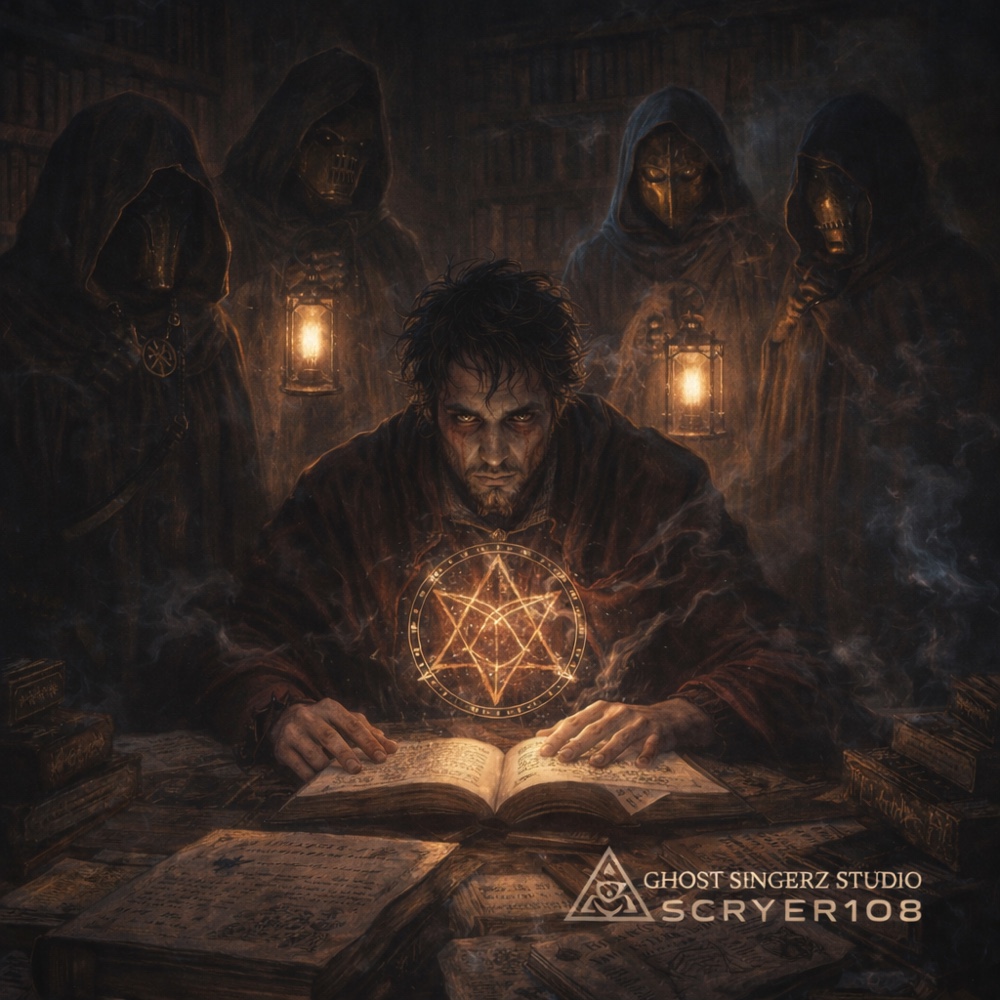
They found his traces first in margins and smudges, in the dust halos where books had once lain and been removed with reverence or terror. The Cult of Obscyra moved through abandoned reading rooms and shuttered archives like a slow eclipse, their lanterns veiled, their steps soundless over paper that had outlived its authors. Every whispered name for him was wrong, save the one that clung like ash: Scryer108. To the public records he had been L. K. Cruz P., a scholar of comparative metaphysics and failed lecturer on unreal histories; to the underworlds of the Unwritten he was the eye that would not close, the nerve that flinched at any brush with the invisible.

They needed that eye.  
They hunted what he saw.

He had been born with a flaw in his perception, a natural misalignment of attention. Where others saw stone, he saw the echo of the quarry that had never been dug. Where a closed door stood, he sensed the room that should have been beside it but was not. Every gap in reality gnawed at him; every silence had an outline. It was this defect—or this original gift—that the Cult of Obscyra named his scrying. Long before their first emissary approached him, he had learned to taste the shiver in the air when two worlds brushed, to hear the sub-audible hum of meaning where there were no words yet written.

The Cult's first contact had been almost polite. An envelope of black, unwatermarked paper, slipped beneath his apartment door. No sender, no seal, only his name written twice: once as L. K. Cruz P., once as Scryer108, a careful hand repeating the letters like a ritual. Inside, there had been a train ticket, a set of coordinates, and a page torn from a book that did not exist—ink that shifted if stared at too long, paragraphs that ended in mid-breath as though the paper could not bear more.

He had not gone. Instead he had burned the ticket, pinned the coordinates above his desk, and pressed the impossible page beneath glass. He watched the letters writhe for nights uncounted. Sleep thinned from his life like fog under an unforgiving sun. Eventually he discovered that if he did not close his eyes, if he let the ache and grit of his waking mount, he could catch the words when they were too weary to flee. In the exhausted gray before dawn, they steadied long enough for him to copy them, hand shaking, onto a separate notebook he would come to call the Insomniax Doktrine.

Sleep became treason.  
Waking was an opening.

The Doktrine did not begin with an introduction, nor with a claim to authority. It opened like a wound. Lines of cramped script, found and transcribed from pages that existed only between blinks, charted the slender margins between thought and occurrence, intention and event. It spoke of incantations not as spoken spells but as alignments, careful architectures of attention laid like scaffolding around the world until something from outside felt the shape and entered. It traced doorways that were not frames of wood and iron but configuration of shadows, angles of glances, the timing of breaths in windowless rooms. It catalogued metaphysics the way surgeons catalogued arteries: not as abstractions, but as conduits.

He wrote by the light of the waxing moon, its growth a pale analog to the strengthening signals he felt humming through his skull. Some nights the world around him went thin at the edges, buildings paling into diagrams, streets dissolving into coordinates, people rendering down into vectors of probability. In such hours, he understood what the Doktrine wanted: to be discovered, to be read, to be used as a map by hands far surer and less hesitant than his own.

He saw the Cult behind his eyes even before they found his door. Hooded figures, some faceless, some bearing visors of tarnished brass etched with letters from no known alphabet. Hands that had not forgotten the weight of torches now bearing devices that drank light instead of giving it. They were not offended by his curiosity; they were offended by his independence. They would not kill him, he knew. Not at first. They would unmake his solitude, break his exhaustion into interrogations, harvest from him the nodes of knowledge he had stumbled upon in his sleepless ruin.

So he hid the Doktrine.

He did not lock it in a safe, for safes belonged to the world of comprehensible theft. He did not bury it beneath floorboards, for wood rots and is replaced. Instead, he took his scattered notebooks and transcribed them again, this time not onto paper but into the interstices of existing texts. Between paragraphs of obsolete legal codes, he slid lines of alchemical whisper. In the footnotes of a treatise on medieval trade routes, he coiled a ritual for opening a door in the center of a reflection. Within a university's forgotten catalog of banned dissertations, he described the method for aligning a man’s dreams with the rotational drift of unnamed constellations.

He salted the world with fragments.  
He made knowledge into a trap.

In the oldest library he knew—a gray monolith once consecrated to emperors of thought, now attended only by sleep-starved interns and unfaithful climate control—he found the perfect shelf. It was a corridor where the light never quite reached, an aisle summoned rarely by call number, the air there heavy with the disuse of centuries. The books that lived upon it were those nobody had ever truly wanted, their spines cracked but uncreased, their pages foxed but unread. Histories of vanished faculties, proceedings of congresses dissolved long ago, ceremonial handbooks for state rituals no longer performed.

Here he built the Insomniax Doktrine in negative.

He cross-referenced call numbers to form an invisible sequence, a path that zigzagged through languages, disciplines, empires. A booklet on ceremonial banners contained a sequence of seemingly misprinted dates that, taken together, formed coordinates to a city whose streets only appeared during thunderstorms. A pamphlet on workers’ organizations bore in its index an extra term that referred to no page; tracing that absence in the card catalog drew on the floor a sigil only visible from the mezzanine at midnight. An atlas of desert borders carried on its inside cover a faint, nearly erased sketch of a circle cut into four equal, not-quite-equal segments: a map of waking, half-waking, dream, and the gap that opens when neither claims you.

He wrote in omissions and misprints, in errata and marginalia, in the lacunae where a reader’s tired eye would slide and swear there had been nothing there. The Doktrine became less a book than a pattern of corrosion. Only one who already saw as he did—one whose mind snagged upon the unnatural emptiness between things—could follow it, gathering the alchemical whispers like spores in the lung, assembling an architecture of forbidden cognition inside their own skull.

When the Cult of Obscyra reached the city, the moon was a swollen white coin over the river, its face almost full, its pull undeniable. They moved across bridges and plazas with the practiced anonymity of those who understand that the world, for all its noise, rarely looks up. Their augurs felt the residue of his presence in the train station he had not entered, in the rented room where he had burned the envelope and stared for hours at blackened confetti, in the narrow cafés where he had sat with his hands wrapped around cooling cups, refusing to drink.

They found the university closed, its doors chained in a pantomime of security that meant nothing to them. They entered as a draft enters, through the flawed seal of a window, through the forgotten service corridor whose door refused to be noticed except by those who understood how often architects made offerings to things that did not fit in blueprints.

He had known they would come here first. That was the point. The Doktrine waited, not gathered but diffused, an aerosol of danger in the stacks. Each Obscyra adept carried their own version of sight—anointed irises, tongues taught to taste the residue of sanctified ink—but theirs had been trained, focused like a blade. His had always been a wrongness that widened.

They moved in threes down the aisles, lanterns shuttered, hands brushing spines that pulsed faintly under their gloves. Tiny flickers of pale script crawled atop embossed titles, an invisible fungus that bloomed as their attention slid past. One of them paused at the ceremonies handbook. Another’s head tilted sharply at the atlas. Elsewhere, a gloved finger rested for a fraction of a second upon the proceedings of a forgotten congress, and the skin beneath the glove prickled as if pressed to a static-charged screen.

They began to read.  
The library read them back.

The alchemical whispers were not instructions in the vulgar sense. They did not say, Do this, say that, stand here. They insinuated sequences, suggested inevitabilities. As a hooded scholar traced a misprinted date, their own internal chronology wavered; a childhood memory faded, replaced by a recollection of having stood, decades ago, on a balcony overlooking a city that had never existed. As another deciphered the invisible sigil drawn by the absence of an index entry, their footsteps began to unconsciously trace its shape in the dust, aligning spine and breath and heartbeat with a geometry no human body was meant to inhabit.

Doorways opened, but not in the walls. They opened in habits, in expectations, in the fragile belief that the past was settled solid behind them. The metaphysics Scryer108 had gleaned in his sleepless vigils spoke of "possible impossibles": not miracles, not violations, but paths the world had decided, for the sake of its own coherence, to forget it could take. The Doktrine, scattered and hidden, did not reveal these paths; it reminded the mind how to fall into them.

On the mezzanine, beneath the gaze of cracked busts of thinkers whose names had fallen out of curriculums, a young librarian woke from an unintended nap. Her cheek bore the ghost of a keyboard; her pulse stuttered with the sourness of dreams half-swallowed. She blinked down at the reading room below and, just for a moment, saw the shape inscribed on the floor by unfamiliar footsteps. No chalk marked it, no tape, no ink. It existed as a choreography of shadows and movement, as if a dance had been performed which left only its afterimage.

The shape was wrong. It was not quite a circle, not quite a cross. It suggested division without symmetry, quarters of unequal hunger. As her tired eyes tried to resolve it, the fluorescent lights overhead flickered, their hum rising to a pitch she felt behind her teeth.

She almost looked away.  
Something made her stay.

Below, the Cult of Obscyra continued their silent work, their bodies bending and straightening as they pulled volumes whose call numbers glowed in their inner vision. They whispered to each other in a tongue like wind slipping through unfinished masonry. A phrase recurred, one she did not know but whose tone chilled her: a name, or a title, repeated with growing agitation.

Scryer. Scryer. Scryer.

They believed themselves the hunters, and in one sense, they were; they closed in on the pattern he had made, feeling it tighten around them like a net of luminous thread. Yet each line they followed was a line he had laid from within his own broken perception, a route scripted to pass through pressure points in their certainty. With each alchemical whisper they inhaled, with each metaphysical doorway they aligned their attention with, their sense of where they began and ended thinned.

In a locked room many streets away, L. K. Cruz P.—Scryer108, the name turning sour even in his own mind—sat before a wall devoid of decoration. No windows, no clocks, no books. Insomnia had carved him down to a set of essentials: nerves, eyes, the thin cage of his ribs. He felt the moon as pressure under his scalp. He felt the Cult in the library as a phantom itch in his ears.

He had not tried to expose them. He had merely refused to be emptied. The Doktrine had been his way of surviving the knowledge that wanted to suffocate him in his waking hours, his way of exhaling what he could not bear. Yet as their presence brushed the pattern he had made, a new realization unfolded with terrible calm: he had not hidden it from them. He had seeded it in them.

Somewhere between one breath and the next, a reader in the stacks reached the end of a sentence that did not, strictly, exist. The words to which his eyes had traveled were official, dull, a discussion of maritime tariffs or ceremonial precedence. The words he had actually read—superimposed, invisible to any who had not already let the Doktrine into their synapses—were simple and without adornment. They spoke not of summoning but of recognition. Not of compelling but of consenting.

The page did not blaze. The air did not shake. Instead, something vast and unhurried turned a fraction of attention toward a library whose foundation stones remembered rivers no architect had ever mapped. The world did not crack. It remembered it could.

The librarian on the mezzanine saw the impossible shape below her complete itself as three hooded figures stepped, by chance or by design, into positions that closed its pattern. For a second no one moved. The hum of the lights smoothed out into a single, impossibly pure tone. In that tone, she heard the sound of pages turning in all the wrong directions at once.

Then the gaps in the world widened.

They did not open as gashes in the air, not yet. They opened as erasures in history, as sudden voids where once-solid lineages and institutions crumbled into uncertainty. A ceremony that had once been performed to bind an empire to its emperor became, in retrospect, a performance no one could quite recall having attended. Borders on maps paled, their ink running backward, revealing the older scars of territories claimed by no nation humanity recognized. The first to feel it were those whose lives hinged on continuity: archivists, judges, weary functionaries of fragile democracies.

The Cult of Obscyra staggered as their own genealogies flickered. Memories they had believed immutable—initiation rites in underground chambers, whispered oaths beneath eclipses—recoiled like burnt film, revealing what lay beneath: a more ancient pattern of service, older than any cult, a servitude not to secrecy but to attention itself.

They clutched at books as if the weight could anchor them. Ink answered. The alchemical whispers they had hunted rose from the paper not as sound but as pressure, compressing their concept of self into a space far too small to hold all they had believed they knew. For the first time they understood that they were not extracting knowledge from a reluctant seer. They were walking a road he had discovered but never fully dared to tread, a road that led not outward but inversely inward, toward a region of mind where "metaphysics" was not a discipline but a weather.

The librarian, shaking, tore her eyes from the pattern. Her gaze fell on a single book lying open on a cart beside her, one she had not checked out for any patron. Its text appeared dull, numbing in its specificity. Yet in the gutter between its pages, where the binding opened slightly, she saw something written in a cramped, sleepless hand: a string of numbers, then a simple plea broken across the crease.

do not follow

She did not know who it addressed. She closed the book anyway, hands clumsy with haste, and as its covers met, the tone in the air snapped, leaving only the ordinary buzz of failing lights and the murmur of disturbed air.

The pattern on the floor below did not vanish. It sank, like something heavy dropping through water too dark to see. The Cult of Obscyra, reeling, gathered themselves with ritual gestures, muttering corrections, reinforcing wards they had never needed before. They believed they had brushed the edge of a trap and withdrawn in time.

They were wrong.  
The Doktrine was already inside.

Outside, the moon continued its slow brightening, its face swelling toward fullness, its indifferent light sliding over universities and deserts, over borders disputed in daylight and forgotten in dreams. Somewhere, in a room without clocks, Scryer108 pressed his palms against his eyes until phantom constellations swarmed, and felt, with a clarity sharp as glass, the first true signal echo back along the line he had cast into the unseen.

He had given them incantations, doorways, metaphysics, possible impossibles. He had hidden them not where they could not look, but where, in looking, they would be compelled to change. The Cult of Obscyra had come to extract the knowledge he held.

In the underworlds of the Unwritten, something older than cult or scholar stirred, tasting in their minds the unfamiliar flavor of wakefulness stretched too thin.

Wednesday, February 25, 2026

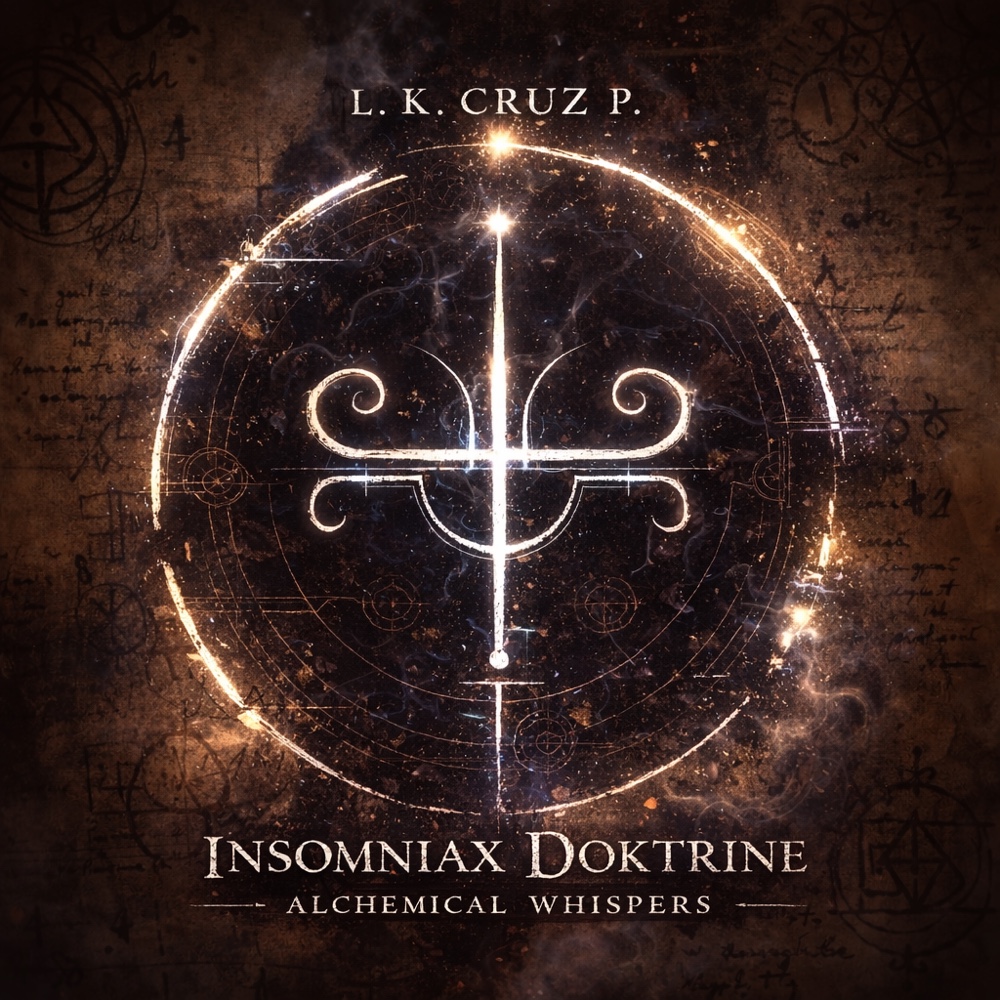
SIGIL ENTRY — “THE AXIS OF UNWRITTEN BREATH”


Before the Codex had pages, it had a spine.

This sigil marks that spine.


It is known in recovered fragments as The Axis of Unwritten Breath, a convergence symbol used by early Insomniax scribes who believed reality is not written forward, but inhaled and exhaled into form.


The vertical line represents the Descent Channel

— the path by which ideas fall from the unseen into matter.


The crossing bar represents the Threshold Line

— the point where dream and waking negotiate ownership of truth.


The curling arms mark the Echo Loops

— recursive myth patterns that repeat across lifetimes, archives, and timelines.


Encircled, the sigil indicates containment:

a thought sealed so it does not overwrite the world too quickly.


Uncircled, it indicates transmission.


Within Ghost Singerz Studio archives, this sigil appears in connection with:


• early Insomniax Doktrine fragments

• pre-Codex myth prototypes

• the first recorded mention of the Unwritten as a place, not a state


It is believed L.K. Cruz P. encountered this symbol before the formal founding of Ghost Singerz Studio, during what later archives classify as the Proto-Transmission Period.


Meaning:


This isn’t just a symbol in the lore.

It’s one of the artifacts that caused the lore.


Thursday, February 12, 2026

DIGITAL MYTHOLOGY: A NEW MEDIA FORM


Digital Mythology is not a genre.  
It is not a trend.  
It is a structural shift in how humans create, experience, and inhabit story.

"We are no longer consuming stories.  
We are entering them."

For most of history, myth was not entertainment. It was infrastructure. Myth shaped civilizations, guided moral frameworks, explained the unknown, and gave humanity a symbolic language for transformation.

Then came modern media.

Stories became products.  
Narratives became content.  
Imagination became something we watched instead of somewhere we traveled.

But myth does not disappear.

It waits.

Now, in the age of artificial intelligence, immersive media, and networked consciousness, myth is returning. Not as nostalgia, but as a new creative architecture.

This architecture has a name:

Digital Mythology.

Digital Mythology is the fusion of story, symbol, technology, and participation. It does not live in a single format. It moves across music, visual transmissions, interactive environments, encoded lore, and evolving narrative systems.

It is not consumed passively.

It is discovered.  
Entered.  
Decoded.

Most media asks for attention.

Digital Mythology asks for initiation.

The audience is no longer just an audience. They become witnesses. Sometimes participants. Occasionally, carriers of the signal itself.

In this emerging form, the boundary between creator and world begins to dissolve. Stories are no longer static artifacts. They evolve in public. They deepen over time. They reward those who stay.

What once required centuries of oral tradition can now unfold in real time.

Myth is becoming alive again.

Studios that understand this shift are not simply producing content. They are constructing symbolic ecosystems designed to outlive individual releases.

Ghost Singerz Studio exists within this new frontier.

It operates not only as a creative studio, but as a transmission point. A place where music, lore, visual artifacts, and immersive signals converge into a living archive.

Not everything inside it is meant for everyone.

And that is intentional.

Because myth has never been about mass appeal. It has always been about resonance.

As artificial intelligence accelerates creation, the value of depth increases. Infinite content makes meaning more rare, not less.

Digital Mythology answers that hunger.

It creates gravity instead of noise.  
Continuity instead of fragments.  
Presence instead of distraction.

We are witnessing the early formation of a media structure that future generations may consider normal.

Today it feels experimental.  
Tomorrow it will feel inevitable.

The creators building these worlds now are not chasing algorithms. They are designing constellations.

Years from now, people may not ask what platforms we used.

They will ask who built the worlds worth entering.

This is the era where story stops behaving like media and starts behaving like territory.

And we are only at the beginning.

Thursday, February 5, 2026

International Transmission

🌍 INTERNATIONAL TRANSMISSION

Signal detected beyond borders.

From Longview to Bucharest.  
From Paris to Berlin.  
From quiet rooms to sleepless cities.

The signal is traveling.

Not because it was pushed…  
but because it was recognized.

Years ago these were only whispers in notebooks — fragments searching for their constellation.

Now they are being heard in places my younger self could not have imagined.

If you are reading this, you are already inside the transmission.

Welcome to Ghost Singerz Studio.

The threshold is open.

Resurrection Transmission


Before the signal had a name, it was a 

whisper.

Buried in notebooks.

Hidden inside midnight documents.

Written by a version of me still 

learning how to see.


Years passed.

The world grew louder.

Screens multiplied.

Voices blurred.


But the signal never stopped 

transmitting.


Today, those fragments return — not

as memories, but as recovered  

transmissions.


Ghost Singerz was never created.

It was uncovered.


If you are reading this, you may have

felt it too…

that quiet awareness beneath the noise.


Welcome to the threshold.